Scholars Mind

World Scholar's Cup · 2026 · Are We There Yet?

Go beyond memorizing the curriculum. Learn to think through it.

The Cup doesn't test trivia. It tests how you reason across subjects under pressure. Scholars Mind synthesizes all 240+ curriculum sources across 6 subjects into structured lessons, 1,389 exam-calibrated questions, and simulators built to official WSC rules.

Section 3 is free forever — no card required.

📚
119 Researched Lessons
954+ key works synthesized
🎯
1-to-N Confidence Scoring
Official Challenge algorithm
✍️
Line-by-Line Coaching
6-dimension rubric feedback
⚡
Timed Media Bowl
200 buzzer audio & art Qs

Tournament Track Record

Built for Scholars. Proven on the Global Stage.

Our curriculum methodology and event simulators were put to the test at the 2026 Global Round with extraordinary results.

Top 10
Global Team Standing
Junior Division overall
Top 3
Writing Champions
Team & individual honors
100%
Yale TOC Berth
Straight to Yale University
100+ hrs
Study Time Saved
240+ sources pre-synthesized

"Digging through 240+ sources on our own took forever. Scholars Mind organized the whole curriculum so cleanly — with lessons, flashcards, and visuals for all the key works that made them way easier to stick in our heads. Instead of just memorizing facts, it taught us the real tensions and cross-subject connections. Having that depth plus instant coaching for Writing and Debate is why our team got fully tournament-ready in such a short time and qualified straight to TOC."

— Junior Scholar, 2026 Global Round Gold Medalist & Yale TOC Qualifier Verified Competitor

The Preparation Gap

Why generic flashcards fall short

The World Scholar's Cup is not a typical trivia bee. Here is how scholars actually prepare, and why depth wins medals:

Method 1

Raw Outline & Web Search

  • ✕ 240+ links, 1.3M+ words of reading
  • ✕ Drowns in Wikipedia tabs
  • ✕ Zero practice questions or exams
  • ✕ No writing or debate guidance
Cost: Free (150+ hours lost)
Method 2

Quizlet / Anki Decks

  • ⚠ Rote name-matching only
  • ✕ No cross-subject connections
  • ✕ Ignores 1-to-N scoring math
  • ✕ Zero essay coaching
Cost: Free (low retention)
Method 3

Outside WSC Coaching

  • ✓ Human tutor interaction
  • ✕ $300–$500 per month
  • ✕ Inconvenient rigid schedule
  • ⚠ Tutors vary in 2026 theme mastery
Cost: $1,200+ per season
Recommended
Scholars Mind

All-in-One Tournament Prep

  • ✓ 119 lessons + 500+ key works
  • ✓ Official 1-to-N Challenge exam simulator
  • ✓ Timed media Bowl buzzer trainer
  • ✓ Line-by-line 6-dimension essay coaching
Cost: $29 solo or $59 for your entire 3-person team

Authentic Tournament Craft

Engineered for WSC. Not Generic Trivia.

Why generic quiz apps fail at WSC — and how our questions mirror the multi-hop lateral leaps, witty distractors, and strategic wagering of the actual Scholar's Challenge.

✕ Generic Trivia Shallow 1-Hop Recall
Question Stem

"Which species of bird was tested in Stephen Emlen's 1967 planetarium migration experiment?"

A) Domestic Pigeon
B) Indigo Bunting
C) Barn Swallow
D) European Robin
E) Common Starling
✕ Zero conceptual depth: Isolated fact recall never asked at Global Rounds or the Yale TOC.
✕ Trivial distractors: Arbitrary bird names give away the answer without testing scientific logic.
✕ Binary scoring: Misses the official 1-to-N confidence wagering math that determines medal standings.
Result: False confidence in practice, sudden struggle in the actual tournament hall.
Tournament-Grade Craft
✓ Scholars Mind AI Robotics × Animal Navigation
Question Stem

"A driverless car that cannot read Marcus's overturned lorry as an obstacle is MOST like an indigo bunting that —"

A) Sings the wrong song
B) Migrates a month early
C) Follows a warmer wind
D) Trusts a false sky
E) Loses its flock
✓ Multi-hop lateral synthesis: Connects autonomous driving failure cases with Emlen's planetarium indigo bunting experiments.
✓ Witty, plausible distractors: Options test why a learned rule breaks when applied outside its training set.
✓ Item-level teaching: Built-in rationale teaches immediately: "A system built from examples cannot tell when it has left them."
Result: Sharpened lateral intuition and instinctual mastery of 1-to-N wagering math.
💡

Witty & Absurd Distractors

Options are crafted with WSC's signature humor and plausible traps — penalizing surface keyword guessing.

Tests true conceptual mastery
🔗

Cross-Subject Lateral Leaps

Questions fuse Art, Science, History, and Literature into interdisciplinary problems that mirror medal-winning Challenge exams.

Interdisciplinary synthesis
🎯

1-to-N Confidence Wagering

Simulates authentic Challenge mechanics: pick 1 option for 1.0 pt, 2 for 0.5 pt, 3 for 0.33 pt, 4 for 0.25 pt or 5 for 0.2 pt.

Official WSC exam math
🏛️

Calibrated to Yale TOC Depth

From essential foundation checkpoints to Global Rounds and Yale Tournament of Champions caliber puzzles, questions advance in authentic rigor.

Regional to Yale TOC progression

Platform Showcase

Designed for Real Tournaments. Built to Win Medals.

Explore the tournament-grade interfaces powering WSC prep — from the visual outline roadmap to line-by-line manuscript coaching, rapid multimedia buzzers, and arcade duels. Try Writing, Debate, and Bowl free — one full run each.

scholarsmind.app/outline
Outline Roadmap & Memory Shield
Collaborative Writing AI Manuscript Coach
Scholar's Challenge Performance Analytics & Coverage
Scholar's Bowl Multimedia Buzzer with Video Stimulus
Llama Dash Retro Arcade Trivia Runner
Visual Syllabus Map Memory Shield Spaced Repetition

Visual Syllabus Roadmap with Adaptive Memory Shield

Navigate all 15 curriculum sections with live countdowns to the Yale Tournament of Champions. The adaptive Memory Shield tracks your retention decay so you review concepts at the exact peak of forgetting.

15 Roadmap Stations Yale TOC Countdown Clock Memory Shield Retention Tracking Speed Run Personal Bests

The Learning Loop

How scholars master the curriculum

1.

Synthesized Lessons

Each outline point gets a clear hook, key concepts, curated works, and cross-subject connections. No open-ended browsing.

2.

Targeted Question Practice

Every question teaches at the item: every option explains why it is right or wrong, grounding your reasoning in the actual curriculum.

3.

Spaced Repetition Review

Adaptive review queues resurface concepts right before you forget them, counting down directly to your competition date.

119
Researched Lessons
954+
Works Synthesized
1,389
Exam Questions
4
Official Event Trainers

Covering all 6 WSC subjects: Art & Music, Literature, History, Science, Social Studies, and Special Area.

Curriculum Synthesis

See an actual curriculum point — free

This is Point 1 of Section 3, shown exactly as scholars study it inside. Complete with synthesized works, interactive concept carousels, and cross-subject links.

Section 3 · Point 1 · More To Do Than Can Ever Be Listed

Seven Ways to Tame a List

Free Preview

Things to do today include exploring the history of the to-do list (alternate link). You’ll find that they were famously used by Benjamin Franklin and Leonardo da Vinci, among other high achievers of history. Below are some more modern approaches to to-do lists to explore—or even try Which format seems best to you?

Benjamin Franklin ran his days off a hand-ruled chart of thirteen virtues. Centuries earlier, Leonardo filled a notebook page with errands — from surveying a city to describing a woodpecker's tongue.

Works

1 / 11
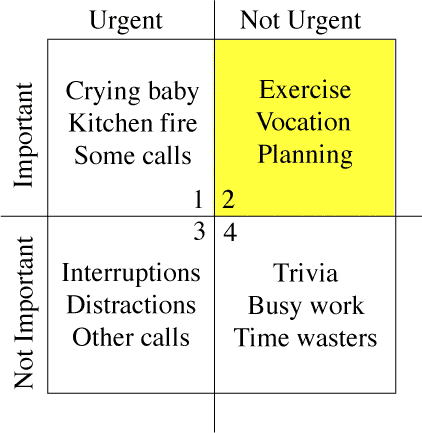
Eisenhower Method
Rorybowman · Public domain

Eisenhower Method

Dwight D. Eisenhower · 1954

Eisenhower quoted a college president: 'The urgent are not important, and the important are never urgent.' Stephen Covey made it a four-box grid of urgent and important: do it now, schedule it, delegate it, or delete it. The box everyone skips, important but not urgent, is the one that builds a life.

1-2-3 Method

1-2-3 Method

Cap the day at three tasks, chosen before it starts: usually one large and two small. The cap does the work. A ten-item list lets you clear the easy things while the hard one survives; three slots force the trade-off into the open.

Ivy Lee Method
Harris & Ewing · Public domain

Ivy Lee Method

Ivy Lee · 1918

Charles Schwab of Bethlehem Steel asked Ivy Lee to make his managers more productive, and to name his fee later. The rule: each evening write tomorrow's six most important tasks in order, and do not touch number two until number one is done. Schwab reportedly paid $25,000.

4-D Method

4-D Method

Four verbs for every task the moment it arrives. Do it if it takes under two minutes. Defer it to a set time, not 'later'. Delegate it. Or Delete it. The fourth is the one nobody performs, so most lists fill with tasks nobody will do and nobody will kill.

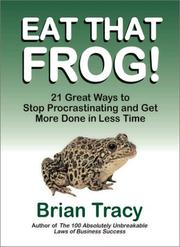
Eat that Frog
Brian Tracy
Brian Tracy · Open Library cover (licensed API)

Eat That Frog ✨ NEW

Brian Tracy · 2001

From a line credited to Mark Twain, though nobody has found him writing it: eat a live frog first thing, and nothing worse can happen all day. Brian Tracy's method: do the ugliest task first, before email and easy wins, while attention is fresh.

Must-Do

Must-Do

The minimal list. Name only what is genuinely non-negotiable today, usually one to three items, and make the rest optional. The day becomes pass or fail: you did the must-dos or you didn't, and everything else is a bonus, not a debt.

Bullet Journal
Ryder Carroll
Nea.salo · CC BY-SA 4.0

Bullet Journal

Ryder Carroll

A paper notebook system built by Ryder Carroll to cope with his own attention problems. Rapid logging uses symbols: a dot for a task, a circle for an event, a dash for a note. The real mechanism is migration: each month you re-copy unfinished tasks by hand, and anything not worth rewriting drops away.

From God to Drew Carey

From God to Drew Carey ✨ NEW

Roy Baumeister and John Tierney · 2011

A chapter of Willpower tracing the to-do list from Genesis, a world made in a six-step plan, through Benjamin Franklin's virtues, to a comedian chasing productivity. A list can bring our highest happiness or our dreariest dissatisfaction, depending on how it is built.

Franklin's clashing virtues

Franklin's Clashing Virtues ✨ NEW

Benjamin Franklin

Benjamin Franklin listed virtues with a goal for each, like Order: 'let each part of your business have its time.' The goals fought. His schedule broke when a client came, because Industry said to meet them, and Frugality ate Industry's hours. Clashing goals bring unhappiness, not action.

Cross out everything from three down

Cross Out Everything from Three Down ✨ NEW

A general at the Pentagon

At the Pentagon, generals were asked for their strategy in 25 words. Only one answered: the one woman in the room. 'First I make a list of priorities: one, two, three. Then I cross out everything from three down.' Blunt, but it reconciles the long term with the short.

Drew Carey's next steps

Drew Carey's Next Steps ✨ NEW

David Allen

The comedian Drew Carey gave his to-do list to David Allen, author of Getting Things Done. Allen taught him to write specific next steps, not big goals. 'Sort out my career' cannot be done today, so it nags like a mother until one small, doable step is taken.

How it reads together

  1. 01 Every method here is subtraction, not storage: Eisenhower deletes a whole quadrant, Ivy Lee stops at six, Must-Do names three, the Bullet Journal makes each survivor earn a re-write. The purest version comes from a general at a Pentagon workshop, asked to sum up her strategy in 25 words: 'First I make a list of priorities: one, two, three, and so on. Then I cross out everything from three down.'

Across subjects

Aviation flipped the tool. After a Boeing bomber crashed in 1935, too complex to fly from memory, pilots invented the checklist — short, fixed, mandatory — and surgeons later copied it. A to-do list is made to be argued with; a checklist is made so nobody decides what to skip.

Theme angle

Crossing off the last item just means the list was too short. Which format is best? One side says hunting for the perfect system is procrastination — the best list is the one you'll keep. The other says the format shapes what you notice: Eisenhower weighs importance, the Bullet Journal makes each task earn its place.

Open this point in full view → 1 of 119 points in the curriculum

Transparent Value

Simple pricing

Start on the free section with zero risk. Unlock everything when your team is ready to compete.

TOC prep promo · $29 solo / $59 team · last day Oct 11 (UTC) · 12 days left
Best Value · 3 for about the price of 2

Season Pass · Team

TOC prep promo $79 $59 one-time payment · 3 scholars

Equip your entire 3-scholar squad through Dec 31, 2026 — full access for 3 scholars for about the price of 2.

  • ✓3 scholars included (captain + 2 teammate links)
  • ✓All 119 depth lessons across 6 subjects
  • ✓1,389+ practice & exam questions
  • ✓Unlimited Challenge, Bowl, Writing & Debate
  • ✓Full access through Dec 31, 2026 (Yale TOC & Yokohama)
Get Team Pass for 3 Scholars →
One-time payment · No subscription

Season Pass · Solo

TOC prep promo $39 $29 one-time payment · 1 scholar

Full tournament prep access for an individual scholar through Dec 31, 2026: the Yale TOC and Yokohama.

  • ✓1 scholar access
  • ✓All 119 depth lessons across 6 subjects
  • ✓1,389+ practice & exam questions
  • ✓Unlimited Challenge, Bowl, Writing & Debate
  • ✓Full access through Dec 31, 2026 (Yale TOC & Yokohama)
Start with Solo Pass →
One-time payment · No subscription
Secure checkout by Stripe · Supported: Credit Card · Apple Pay · Google Pay · Alipay